


Julie wants running shoes for wet pavement. Two years ago, she would have typed “best waterproof running shoes” into Google, clicked through ten blue links, bounced between review sites, and eventually bought something from the brand that ranked highest and had the most convincing landing page.
Today she asks ChatGPT. It recommends three shoes. Your product is not one of them.
Your shoe isn’t bad. It’s not that expensive either. It’s just invisible. The AI intermediary that now sits between your product and your customer could not understand what your product does, who it is for, and where it falls short.
Welcome to the era of AI-mediated discovery. Your product now has two users. The human who uses it, and the AI that decides whether the human ever sees it.
The Numbers That Should Scare You
This is not a hypothetical future. It is already here, and the data is brutal.
Over 80% of all searches now end without a single click. When a Google AI Overview appears, that zero-click rate climbs to 83%. Click-through rates drop from 15% to 8% when an AI Overview is present, a 58% reduction. The click, once the atomic unit of digital discovery, is becoming an endangered species.
But that data isn’t indicative alone. Sure, information seekers clicking on fewer links adds noise. Not everyone is looking for product recommendations after all. Some of us just want to know if Koalas are vegan. So here’s some more well rounded data that proves my point:
SOCi analyzed over 350,000 locations across 2,751 multi-location brands and found that ChatGPT recommends just 1.2% of them. Google’s local three-pack shows 35.9%. That makes AI recommendation roughly 30 times more selective than traditional search.
Read that again: 30 times more selective. If traditional search was a funnel, AI-mediated discovery is a needle.
Meanwhile, the traffic that does come through AI channels is surging. AI-driven traffic to US ecommerce sites increased 758% year over year by November 2025. According to IBM’s study with NRF, 45% of consumers now turn to AI during buying journeys: 41% to research products, 33% to interpret reviews, 31% to hunt for deals. About a third of US consumers say they would let an AI make purchases for them entirely.
This is not a trend that might matter someday. This is the new distribution channel. And your product is either legible to it or invisible within it.
The Old Playbook Is Broken
For two decades, the discovery playbook was straightforward. Rank for keywords. Drive traffic. Convert on-site. The entire machine was built on the assumption that discovery happens through a list of links, and the winner is whoever sits highest on that list.
AI-mediated discovery breaks every piece of that machine.
Non-brand, awareness-driven B2B traffic has declined by up to 60% as AI search reduced click-through behavior. These companies watched something deeply disorienting happen: their search rankings stayed stable, but the clicks disappeared. They were still “winning” at SEO. The traffic just stopped arriving. The game changed around them while the scoreboard kept showing the old score.
When a user asks an AI a question, the AI does not return a list of links for the user to evaluate. It returns an answer. It synthesizes, filters, compares, and recommends. This is the fundamental shift: your product is no longer competing for a user’s attention. It is competing for an AI’s comprehension.
What AI Intermediaries Actually Reward
The brands ChatGPT recommends are not the biggest. They are the most legible.
Recommended locations average 4.3-star ratings. AI platforms heavily weight sentiment. Not volume of reviews, but consistency of positive signal. More importantly, AI rewards cross-channel consistency over strength in a single channel. A brand that is excellent on its website but thin on Google, Yelp, and social profiles performs worse than a brand that is consistently good across all of them.
This is a fundamentally different optimization target than traditional SEO. Search engine optimization rewarded you for being strong in one place: Google’s index. AI-mediated discovery rewards you for being coherent everywhere.
The second pattern is even more counterintuitive. Constraint-focused product content outperforms feature-focused content for AI recommendations. “Best for daily commuters; water-resistant for light rain, not heavy downpours” beats “advanced waterproof technology with moisture-wicking lining.” The AI intermediary is not looking for marketing language. It is looking for specificity about what your product does, who it serves, and, critically, where it does not work.
Think about why. When a user asks an AI for a recommendation, the AI is trying to match a specific need to a specific product. Feature lists are noise. Constraints are signal. The AI needs to know what your product is not good at just as much as what it is good at, because that is how it avoids recommending the wrong thing to the wrong user.
The Second-Order Consequences
This shift does not stop at “optimize your product data.” The incentives underneath AI-mediated discovery are different from search, and that difference compounds.
Google monetized clicks. Large language models monetize sessions. Their economic incentive is to keep users inside the interface, deliver a high-confidence answer, and reduce friction. That means fewer options, higher precision, and lower cognitive load. A list of ten links was acceptable when the click was the business model. A single synthesized answer is required when retention is.
Right now, most AI interfaces recommend three to four products. In many categories, eight to twelve products could legitimately satisfy the user’s constraints. The compression is already severe. When sponsored placements enter the system, surface area shrinks further. If one slot is paid and one is reserved for a trusted integration, you are effectively competing for one or two organic positions. This is not SEO with better copy. It is a high-precision, low-inventory discovery economy.
Here, discoverability becomes winner-takes-most. Marginally legible products do not receive marginal traffic. They disappear. From the AI provider’s perspective, monetization must remain tightly coupled to relevance. If AI platforms degrade recommendation quality for ad revenue, users leave. Unlike search engines, they cannot fall back on ten blue links. Trust is the product.
There is another layer. Today, structured constraint data is an advantage. Tomorrow, it becomes table stakes. When every brand expresses “best for daily commuters, not ideal for heavy rain” in clean, machine-readable form, differentiation moves elsewhere. The AI must choose among equally legible products.
What does it optimize for then? Likely the lowest probability of user regret. Consistent satisfaction signals. Return rates. Review stability. Cross-channel coherence. In that world, operational excellence beats marketing brilliance. The brands that win are not those with the loudest features, but those with the most reliable outcomes.
The Trust Layer Underneath
Before you rush to “optimize for AI,” there is a critical nuance.
Only 46% of shoppers fully trust AI recommendations. And 89% still check information before buying based on an AI recommendation. The AI intermediary is not a decision-maker. It is a filter. It narrows the consideration set from everything to three or four options. Then the human takes over.
This means the AI is deciding who gets into the room. But the human is still deciding who wins.
Your product needs to pass two tests now, in sequence. First, can the AI understand it well enough to recommend it? Second, once the human arrives (from the AI recommendation), does the product experience close the deal?
What This Means for Builders
The implications are immediate. Your product’s discoverability is no longer just a marketing problem. It is a product data problem. How your product describes itself in its attributes, constraints, use cases, and limitations, determines whether it passes through the AI filter.
Does your product data describe constraints and use cases, or does it describe features and benefits? Does your product information maintain consistency across every surface it appears on, or is it fragmented across channels with different messaging on each?
If you are a startup founder, there is a genuine opportunity here. AI recommendation is more meritocratic than traditional search in one specific way: it rewards data density and accuracy over brand size and ad spend. A small brand with thorough, constraint-focused product data can outperform a Fortune 500 brand with thin product pages. You do not need a massive SEO team or a big advertising budget. You need clear, specific, honest product data that an AI can parse and match to user intent.
Here is the practical checklist.
Audit your product data for AI legibility. Take your top 10 product pages. Ask ChatGPT, Gemini, and Perplexity to recommend a product in your category for a specific use case. Are you in the results? If not, look at who is and study their product data structure.
Shift from features to constraints. Rewrite your product descriptions to explicitly state who the product is for, what specific problems it solves, and where it falls short. “Works best for X. Not ideal for Y.” This feels counterintuitive. Why would you highlight limitations? Because the AI intermediary uses limitations to make accurate recommendations, and accurate recommendations build trust in the AI’s suggestions.
Ensure cross-channel consistency. Your product data should tell the same story on your website, Google Business Profile, Amazon listing, social profiles, and review platforms. The AI is synthesizing across all of them.
Monitor AI recommendations, not just search rankings. Your weekly check should now include “what does ChatGPT recommend for [your category] + [specific use case]?” Track this the way you track keyword rankings. Build it into your product analytics workflow.
Design your product information architecture for machines, not just humans. Structured data, consistent taxonomy, explicit attribute-value pairs. The prettier your product page is for humans, the less useful it may be for AI intermediaries if the underlying data is trapped in marketing copy rather than structured fields.
The Opportunity Behind the Disruption
Retailers who have already adapted to this shift are seeing results. Those adopting conversational, intent-driven search internally reported a 35% drop in zero-result queries and a lift in first-click conversion. Companies implementing AI-powered discovery report conversion lifts of 20-40%.
Major retailers like Walmart, Target, and Etsy are integrating directly with ChatGPT, Gemini, and Copilot, allowing purchases within AI conversations. The transaction layer is moving into the AI intermediary’s environment. If your product is legible to these systems, you are not just getting discovered, you are getting purchased without the user ever visiting your site.
The irony is beautiful: in a world of AI intermediaries, the competitive advantage is radical clarity about your product.
What Comes Next
We are still early. The AI-mediated discovery layer is clumsy, inconsistent, and sometimes wrong. The 46% trust number tells you that consumers know this. The 89% verification rate tells you humans are not blindly following AI recommendations.
But the behavioral shift is locked in. The zero-click trend, the 758% traffic surge, the one-third of consumers willing to let AI buy for them. These are not numbers that reverse. The intermediary layer between your product and your user is only going to get thicker, more capable, and more selective.
The products that start designing for two users now, the human who uses the product and the AI that recommends it, will have a compounding advantage. Not because they cracked some new marketing hack. Because they did the hardest, most boring, most valuable thing in product development.
They made their product easy to understand.
That running shoe for wet pavement? The one the AI did not recommend? The product was fine. The data was not. Same shoe. Same quality. Same reviews. But one had structured, constraint-specific product data that an AI could parse, and the other had a beautiful landing page full of marketing copy that a human loved and an AI could not decode.
Your product now has two users. Design for both of them, or the one that matters most will never know you exist.
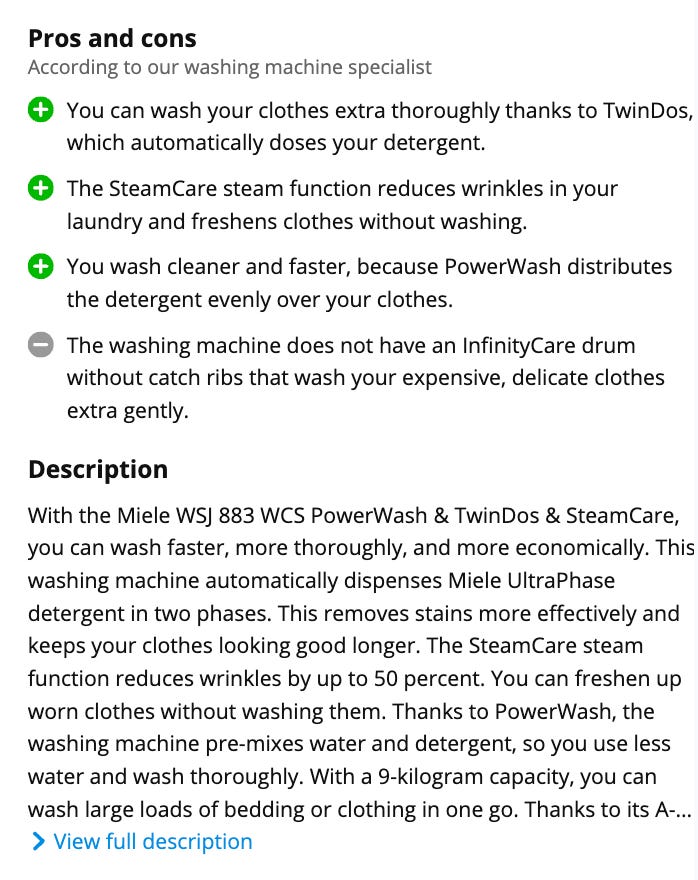
PS: My most favorite electronics e-commerce brand is CoolBlue. I’ve bought all my laptops and phones from them, all my home appliances, even an entire kitchen. Most of it online. They’ve been doing the Pros and Cons list (and a fantastic product page) for ages.
Great reminder about how fast the world of discovery is changing, Pranav -- thanks for posting. Maybe pin a reminder to publish an update after six more months? Cheers!
If was funny story I heard on a podcast. A startup who basically did a comparison page of all the different vendors for their solution and rated their own the best one in class. They capitalised massively on this